Life In the Blue Zone — I'll Have What the Centenarians Are Having
There is a version of this idea that sounds almost embarrassingly simple: if you want a result you keep seeing in others, look closely at what they keep doing. Not what they say they do. Not the highlight version, edited for inspiration. The actual repeated behaviors — the daily, unglamorous, consistent ones — that produce what you're looking at over time. The sushi master who washes rice for a decade before he touches a fish. The writer who shows up at the desk every morning before she feels like it. The gardener who prunes in February when nothing is blooming yet.
Now apply that lens to the people who live the longest, most vitally, on earth. What do they keep doing? More specifically — what do they keep eating?
The Blue Zones are five regions where researchers found unusually high concentrations of people living past one hundred, and living well past it — cognitively sharp, physically mobile, embedded in community. Sardinia, Italy. Okinawa, Japan. Nicoya Peninsula, Costa Rica. Ikaria, Greece. Loma Linda, California. Different cultures, different geographies, different languages. And yet when you look at what they eat, the patterns converge in ways that are too consistent to ignore.
✦
Five Places. One Pattern.
Before we talk about what to put on your own plate, it's worth sitting with where these patterns come from. Each Blue Zone has its own culinary character — Sardinian pecorino and Cannonau wine, Okinawan purple sweet potato, Nicoyan black beans and corn tortillas. The particulars differ. The architecture beneath them is remarkably similar.
Blue Zone ISardinia, Italy
Whole grain flatbread, fava beans, sheep's milk cheeses, garden vegetables, small amounts of Cannonau wine
Blue Zone IIOkinawa, Japan
Purple sweet potato, bitter melon, tofu, seaweed, small fish, minimal meat across a long life
Blue Zone IIINicoya, Costa Rica
Black beans, corn tortillas, squash, eggs, tropical fruits — simple, inexpensive, deeply nourishing
Blue Zone IVIkaria, Greece
Olive oil, wild greens, legumes, herbal teas, potatoes — a Mediterranean diet lived at its unhurried best
Blue Zone VLoma Linda, California
Largely plant-based Adventist diet: nuts, legumes, oatmeal, whole grains, no alcohol
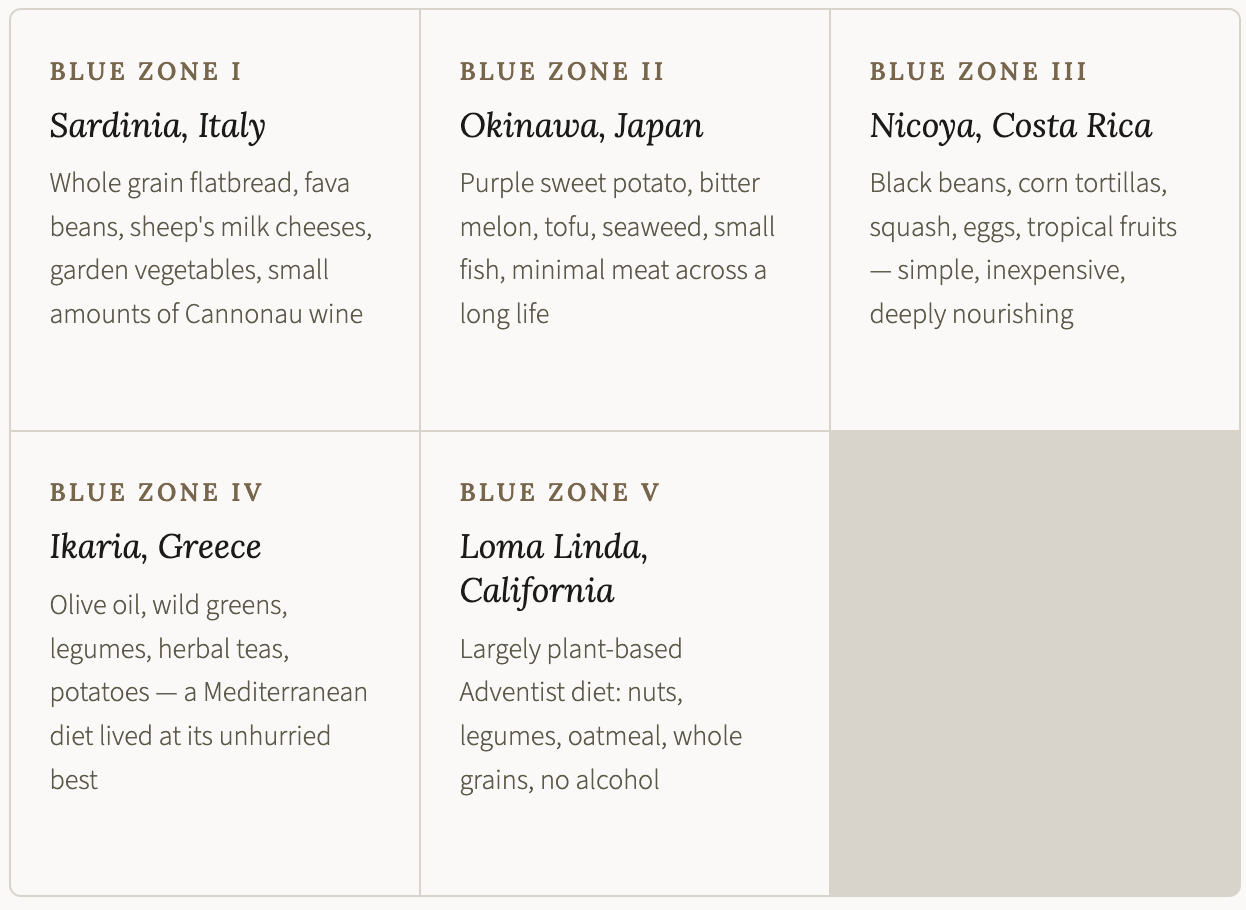


Look at those five and something becomes obvious: none of them are built around restriction. None of them are diets in the modern sense of the word — punishing, finite, oriented toward a goal after which you stop. They are simply how people eat. Day after day, year after year, decade after decade. The repetition is the point.
Longevity isn't a destination these communities arrived at. It's the accumulated result of ten thousand ordinary meals.
✦
The Pattern Worth Copying
Across all five zones, researchers identified a core dietary pattern. It's not a rigid prescription — the Ikarians eat differently from the Okinawans in almost every cultural sense — but the underlying architecture is consistent enough that it functions as a kind of template.
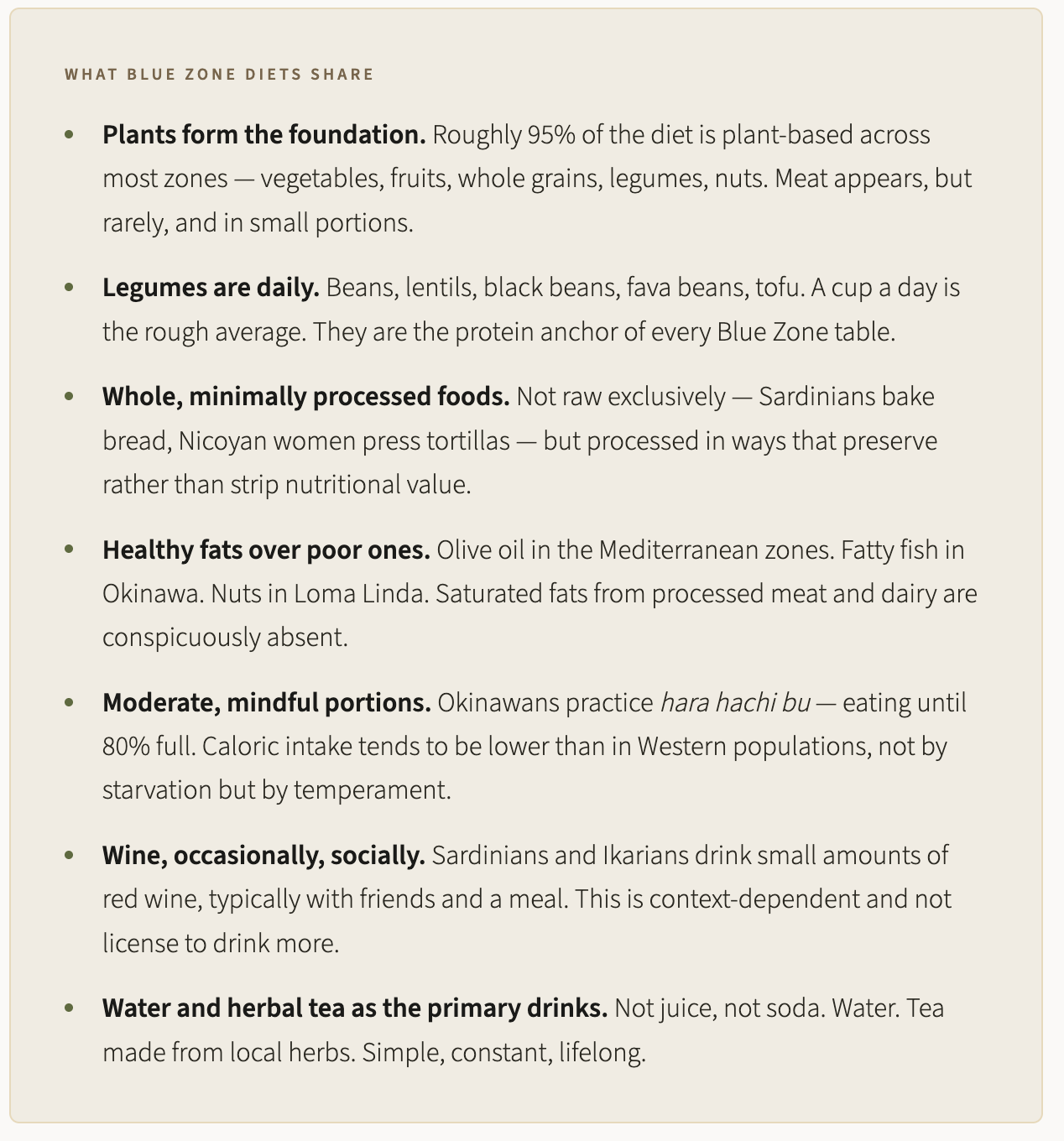
This is the pattern. It isn't secret knowledge. It has been written about, studied, and documented extensively. And yet most of us don't eat this way — not because we can't, but because the pattern requires something more than information. It requires repetition. It requires deciding that this is simply how we eat now, and then making that decision again and again until it stops feeling like a decision at all.
✦
Why Copying Works
There's a version of wellness culture that treats every new study as a revelation and every old habit as something to be optimized away. The Blue Zone research points in the opposite direction. The 104-year-old Sardinian shepherd didn't achieve longevity by optimizing — he achieved it by repeating, for a century, a way of eating that was passed down to him without ceremony or explanation.
Consider the lilies of the field, how they grow; they toil not, neither do they spin — and yet Solomon in all his glory was not arrayed like one of these.— Matthew 6:28–29
The lilies don't optimize. They simply do what they were made to do, fully and repeatedly, without revision. There is something in this that applies to how we approach food and longevity. The centenarians of Ikaria didn't track their macros. They grew vegetables, cooked them in olive oil, ate with family, and went to sleep. They did this for ninety years. The discipline was invisible because it was simply life.
This is what copying actually means — not mimicking a surface behavior for thirty days, but looking closely enough at a pattern to understand its structure, and then building that structure into your own life. The Nicoyan woman who makes beans every day doesn't think of it as a longevity strategy. She thinks of it as lunch. That's the goal: for the pattern to become ordinary.
✦
Where to Begin
You don't need to live in Sardinia. You don't need to adopt a different culture wholesale. The researchers who documented the Blue Zones were clear that the dietary pattern is transferable — it's the pattern that matters, not the specific geography or tradition that produced it.
To be clear: the centenarians of Sardinia weren't just eating well. They were walking steep hills, growing their own food, and eating dinner with people they'd known for seventy years. The diet is the most portable lesson. The rest is worth paying attention to too.
So: more legumes. More vegetables. Whole grains as the baseline, not the exception. Olive oil in place of butter where it makes sense. Less processed meat, or none. Water and tea, habitually. Smaller portions, eaten slowly, with people you love when possible.
None of that is dramatic. None of it trends. But the shepherd in Sardinia wasn't trying to trend — he was trying to eat, day after day, in the way his community had always eaten. And here he is, at one hundred and four, still walking his goats up the hillside before breakfast.
The most powerful diet isn't the one you follow for six weeks. It's the one you'll still be eating in thirty years.
Start with one meal. Cook beans this week — really cook them, from dried if you have the time, or canned if you don't. Add more olive oil than feels appropriate and some greens you wouldn't normally buy. Eat it slowly. Notice how it feels. Then do it again next week. And the week after that.
The Blue Zone centenarians didn't earn their longevity through willpower. They earned it through repetition — through the quiet, patient, unglamorous act of eating well, over and over, across the entire span of a long and ordinary life.
That pattern exists. It's been documented. It's been studied. It works.
Copy it.
Yes, people have called Blue Zones a myth — and they're not entirely wrong to ask the question. But a 2025 peer-reviewed response in The Gerontologist, co-authored by one of the original Blue Zone researchers, walked through the age verification process in detail and concluded the data holds up. The patterns are real. The question is just whether we'll copy them.