On Keeping Lilies In an Enclosed Room
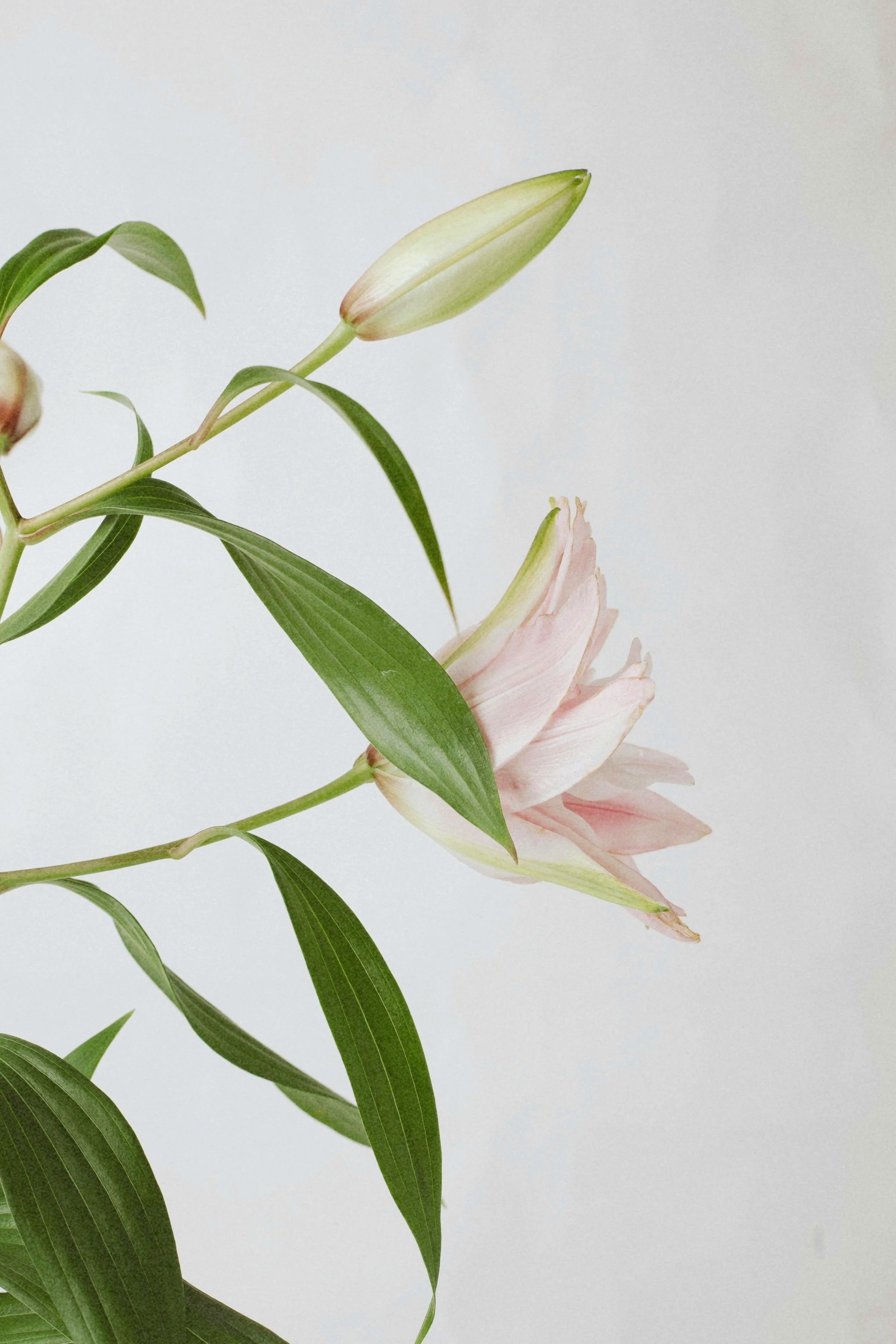
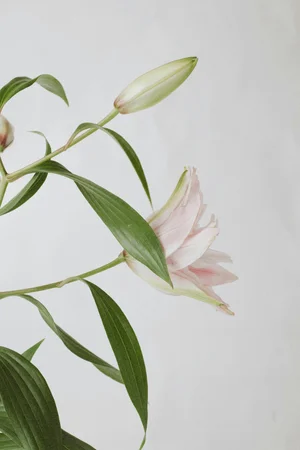
A blush pink lily, the bud still closed beside the open bloom. One has given everything away. The other stands guard over that generosity — it's exactly the tension the essay is about.
Something on the verge, something already arrived. And a cool grey-white background makes the lily feel like it's the only thing in the world, which is precisely how it behaves.
There is a lily on my nightstand, and I am not entirely sure I will survive it. This is not hyperbole — or rather, it is precisely the kind of hyperbole that contains, like a blossom folded tight, a kernel of literal truth. The scent has colonized the room. It moves through the air not as a whisper but as a pronouncement, thick and syrupy, the olfactory equivalent of velvet dragged slowly across the skin. I wake into it. I fall toward sleep inside it. The air purifier hums its small, democratic hum in the corner, and the lily ignores it entirely.
Proust understood, perhaps better than anyone, that smell is the one sense that refuses to stay in its lane. It does not simply register; it transports. It reaches beneath the polite fiction of the present moment and drags you — gently, then not so gently — into something you had almost managed to forget you were carrying. A madeleine dipped in linden-flower tea, and suddenly thirty years collapse like a paper fan. Smell is the sense that does not believe in time. I think of this lying in bed, the lily performing its slow exhalation above me, and I wonder where it is taking me, what door it is pressing open in the back of the house of myself.
The scent does not ask permission. It arrives the way grace is supposed to arrive — unbidden, a little overwhelming, and somehow exactly sufficient.
The particular sweetness of a lily is not innocent. It is not the sweetness of a strawberry, bright and transient, gone before it has fully arrived. It is the sweetness of something fermenting, something at the outermost edge of itself — generous to the point of excess, perfumed past the point of decorum. There is in it a note that is almost animal, almost funereal, almost liturgical. The ancients were not wrong to place lilies at altars. They are the flowers of annunciation and of burial both, which may be the same thing if you look at it from a sufficient remove.
opulent
fugitive
sacred
fermented
golden
opulent fugitive sacred fermented golden
I think about what it means that I am afraid of it — that the sweetness has crossed some threshold into something that registers in the body as warning. This is the paradox of the lily's perfume: it is so purely itself that it begins to feel like too much. And yet I do not move it. I do not open the window. I lie in the dark and breathe it and feel, not unpleasantly, like something being slowly dissolved. Proust's narrator, tasting his tea, was flooded with involuntary joy. I am flooded with something less nameable, something that lives just below joy, in the warm country adjacent to it — awe, perhaps, or its secular cousin, wonder.
✦ ✦ ✦
“And why do you worry about clothes? See how the flowers of the field grow. They do not labor or spin. Yet I tell you that not even Solomon in all his splendor was dressed like one of these. If that is how God clothes the grass of the field, which is here today and tomorrow is thrown into the fire, will he not much more clothe you—you of little faith?”
Consider the lilies. It is one of those instructions that sounds, on first hearing, gentle — pastoral, even. But the longer you sit with it, the stranger it becomes. Consider is not a casual verb. It asks for sustained attention, for the kind of looking that takes time and does not flinch. And what you are being asked to consider is not the lily's utility, not its symbolism, not what it might represent. You are asked to consider the lily itself — the fact of it, the sheer gratuitous fact of it. The way it blooms not for anyone in particular but simply because that is what it is and what it does. The way it smells not as communication but as pure, uncalculated emanation.
Look at the bud beside the open bloom in the cover photo — how it stands upright, still sealed, as though protecting its neighbor's extravagance. As if one must remain in reserve so the other can be entirely given away.
The verse is, among other things, an argument against anxiety. But I think it is also something stranger: an invitation to take extravagance seriously. God, the argument goes, dressed the lilies the way God dresses things when left to His own devices — without restraint, without apology, in a glory that makes Solomon's gold look like something that tried too hard. The lily does not try. The lily simply is, fully and recklessly, petals thrown open, pollen offered freely to the air, scent released as though scarcity were a concept it had never encountered.
God clothed the lily in a perfume it didn't earn and doesn't explain. The lily asks no permission to be overwhelming.
This is the lily's theological argument, made nightly against my ceiling: abundance is not an error. Excess is sometimes the appropriate response to existence. The scent that fills my room until I feel faintly intoxicated — that is not the lily misbehaving. That is the lily being precisely what it was made to be, giving precisely what it has to give, holding nothing in reserve. There is a lesson in this that I am still learning. The air purifier hums on. The lily does not negotiate.
Proust spent decades reconstructing lost time from the wreckage of sensation — following the thread of a smell back through the labyrinth until he found the room at the center of it, the room where the self was formed and where it might, at last, be fully known. I am not writing a seven-volume novel. I am lying in bed in the dark, breathing a flower. But I think the project is related. The lily's scent does not let me remain abstract. It makes me present — present to my body, present to the night, present to the strange fact that I am here at all, in a room, in a life, breathing in and breathing out, marvelously, perishably alive.
So I keep the lily on the nightstand. I keep it there because it asks something of me, because it refuses to let the room be merely a room. Because the sweetness that frightens me a little is also the sweetness I want to be near — the sweetness of things that exist without apology, of beauty that does not make itself smaller to avoid making you uncomfortable. The air is thick with it now. I am, perhaps, intoxicated. I think this is what the field was always offering. I think this is what we were meant, when told to consider, to find.
— Written in a room that smells of lilies · After Proust, and after Matthew.