The Most Beautiful One
For nearly two thousand years, Yeshua has been the most painted subject across more cultures and traditions than any other figure in human history. Why?
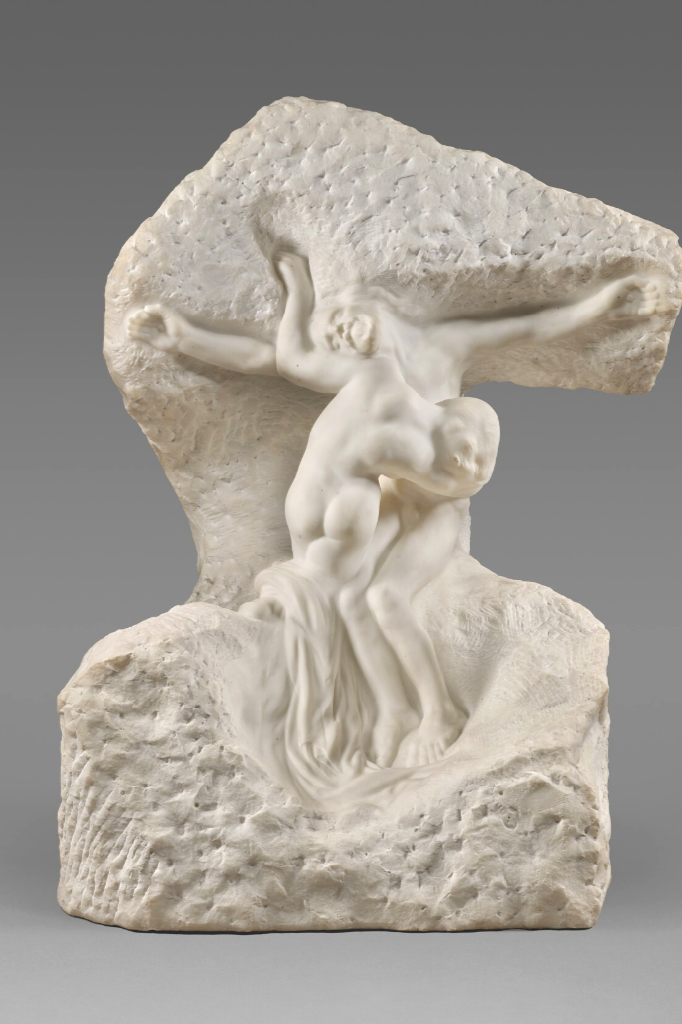
Auguste Rodin, Christ and Mary Magdalene, 1908. Marble. The J. Paul Getty Museum, Los Angeles.
Photo © The J. Paul Getty Museum.
Walk into any museum in the world — the Louvre, the Uffizi, the Met, a small regional gallery in a country you've never visited — and you will find Him. His face, His story, the same body rendered again and again across every century and culture and medium available to human hands. I find it remarkable that with two thousand years of images, every single one was made without an eyewitness description of what He looked like.
The men and women who walked with Him never described what He looked like. The four Gospels, together a mix of eyewitness, compiled, and reported accounts, contain no physical description of Him. And even Mary Magdalene, the woman who stayed at the foot of the cross when others fled, who was first at the tomb, and who had her own gospel, left no physical description of Yeshua. Or if she did, it has not reached us.
And yet, no figure has inspired more acts of artistic devotion — paintings, sculptures, cathedral ceilings, gold icons, devotional panels small enough to carry in a pocket, jewelry, poetry, music. No one has been painted more and no individual has generated more art.
What we do have is extraordinary. The teachings, the miracles, the encounters, the death, the resurrection, the testimony of everyone who was changed by Him. That’s an overwhelming abundance of material. The strangeness isn't that artists have so little to work from. It's that with all of what we have, none of it includes a face. And still every generation picks up the brush, the chisel, the pen.
It’s worth asking why. What is it about this one life and story that’s kept every generation reaching for new ways to render it. These were my thoughts after a visit to the Getty in Los Angeles, standing in front of a marble sculpture called, among other names, Christ and Mary Magdalene. A dying man, arms outstretched, nailed to rough stone. Pressed fully against him, a woman’s body curved around his suffering. The stone around both figures — Rodin's signature non finito from Michelangelo — is rough and uncarved, as though the bodies have emerged from the rock or are being absorbed back into it. A Jesuit blogger who stood before this work described Mary Magdalene’s nakedness as an act of solidarity, of communion, and shared humiliation. He called it a kind of Eucharist. This is my body which is given to you. Rodin imagines Mary pressing herself against the dying Christ with everything she has. A desperate nearness which makes the scene at the tomb three days later even more piercing, where, reaching for Him there, she is met with the gentlest possible words, “Do not cling to me.”
Something about it demanded a closer look. What is the nature of Yeshua’s beauty, and what keeps drawing our hearts toward Him with our creative endeavors? No likeness of Yeshua was ever preserved, and yet He remains the most painted figure in human history. I wanted to understand that. Why, without a recorded face or earthly image to guide them, have artists across centuries been reaching toward something unseen yet deeply felt — toward a reality disclosed not by appearance but by the beauty of His nature and the love He poured out for us. I believe that whatever draws the human heart to Him is bound up with true beauty, for beauty in its deepest sense goes beyond what pleases the eye and awakens longing for the divine. And no one has stirred that longing more deeply, or more enduringly, than Yeshua.
The Prophetic Descriptions
While writing this piece I went looking for any physical description of Yeshua and found that the only ones that exist are prophetic. The only people who ever tried to describe Him were not artists at all. They were prophets. And one of them saw no physical beauty in Him whatsoever.
Isaiah wrote seven centuries before Yeshua's birth. John wrote in exile on the island of Patmos toward the end of the first century, after Yeshua’s resurrection. One saw Him coming and one saw Him after He had passed through everything. Neither saw Him as one standing in a crowd might see Him. Rather, each was given something closer to divine revelation and what they recorded is the nearest thing we have to a portrait of Him.
What Isaiah Saw
Isaiah wrote his fifty-third chapter seven centuries before Yeshua was born. The identity of the suffering servant has been debated for centuries, with Jewish tradition either reading the figure as Israel collectively or as another figure entirely. For those who read it as Yeshua, what makes verse two extraordinary is that it contains the only prophetic reference to His ordinary earthly appearance. John's later vision on Patmos would show Him in His glory, a figure of overwhelming majesty and power. But Isaiah saw Him before all of that. Verses two and five of Isaiah 53 are the ones I keep returning to.
He hath no form nor comeliness; and when we shall see him, there is no beauty that we should desire him.
- Isaiah 53:2 KJV
I named this blog post The Most Beautiful One while the only prophetic glimpse of His earthly appearance tells us there was nothing there to desire. If Isaiah’s servant is Yeshua, then the one prophet who saw Him coming described Him as ordinary, the kind of person you could pass on the street without a second glance. Isaiah’s vision is marked by plainness, for there was no beauty in Him that we should desire Him, nothing in His appearance that would make us truly see Him when He came.
And yet here we are. Two thousand years of reaching toward Him.
But then Isaiah pivots away from the face entirely and moves toward something else:
But he was wounded for our transgressions, he was bruised for our iniquities: the chastisement of our peace was upon him; and with his stripes we are healed.
- Isaiah 53:5 KJV
For Isaiah, this is where Yeshua’s beauty is found. Not in a face without comeliness and not in the wound itself but in what the wound was for.

Hans Holbein the Younger, The Body of the Dead Christ in the Tomb, 1521–1522. Oil on limewood. Kunstmuseum Basel, Switzerland. Public domain via Wikimedia Commons.
The suffering servant of Isaiah is not just a man who suffers, for history has no shortage of those. He is a man whose suffering is directional, “wounded for,” “bruised for”. A great deal of theology rests on that preposition. This is suffering chosen and on offer, suffering that moves in one direction — toward us — and accomplishes something in the movement. That is what Isaiah saw. Not a face but a love, and perhaps that is exactly what every artist has been trying to render ever since.
What John Saw
Then there is John.
Seven hundred years after Isaiah, John is writing from exile on Patmos when the vision comes. He hears behind him a voice like a trumpet and turns to see its source. What appears before him, if this is the same John who once walked beside Yeshua, is not the man he had known before. Among the visions John receives, three stand out for what they reveal about Yeshua.
In the first chapter, John beholds a figure standing among lampstands, white-haired, with eyes like flame and a voice like many waters, and John falls at His feet before Him:
His head and his hairs were white like wool, as white as snow; and his eyes were as a flame of fire; And his feet like unto fine brass, as if they burned in a furnace; and his voice as the sound of many waters. And he had in his right hand seven stars: and out of his mouth went a sharp two edged sword: and his countenance was as the sun shineth in his strength.
- Revelation 1:14 -16 KJV
In chapter five, John is told to look for the Lion of Judah, a figure of power and conquest bearing the kind of majesty the world instinctively recognizes. He turns expecting a conqueror. What he sees instead is a Lamb. Standing, but bearing the marks of slaughter. Alive, but unmistakably wounded. The inversion is the whole point and the whole of the gospel in a single image. The one who was worthy to open the scroll, to hold the fate of history in His hands, was not the conquering king anyone had imagined. It was the one who had given everything all the way through death and came out the other side still standing. The Lion of Judah turned out to be a Lamb, and the Lamb turned out to be worthy of everything.
The glory of the Lamb is not the glory of strength withheld. It is the glory of strength spent completely, and still standing. Near the end of John’s visions on Patmos, heaven opens again:
His eyes were as a flame of fire, and on his head were many crowns; and he had a name written, that no man knew, but he himself. And he was clothed with a vesture dipped in blood: and his name is called The Word of God. And out of his mouth goeth a sharp sword, that with it he should smite the nations. And he hath on his vesture and on his thigh a name written, KING OF KINGS, AND LORD OF LORDS.
- Revelation 19:11-16 KJV
This is the same person, the servant Isaiah saw and the King that John beheld. The humility in Isaiah and the majesty in John do not contradict each other but are expressions of the same nature revealed at different moments, like the same fire seen from different distances. The white hair is not age but eternity and the eyes of flame are not anger but a vision that burns through everything. The voice like many waters is not mere volume but a presence that fills every corner and leaves nothing untouched.
What Isaiah and John describe across seven centuries is the same glory seen from different sides of the cross. Isaiah saw the wound before it was given. John saw the one who bore it, first among the lampstands and then riding from open heaven as King of Kings. This is love wounded for us, and love the wound could not overcome.
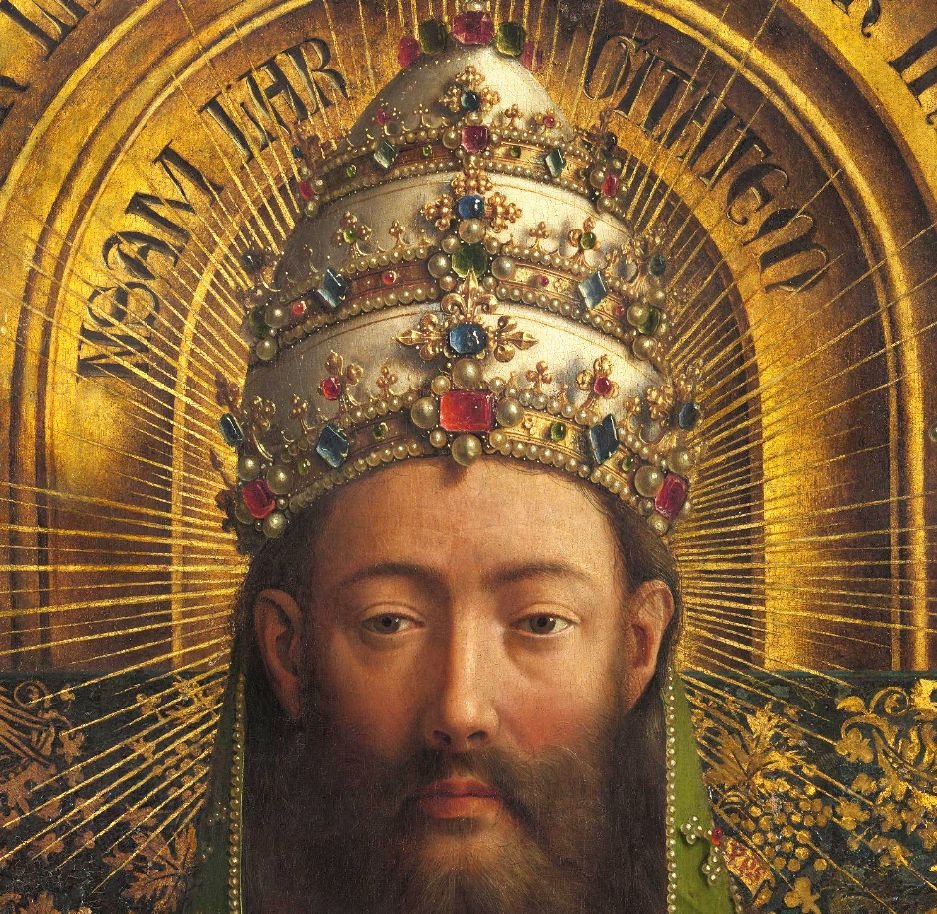
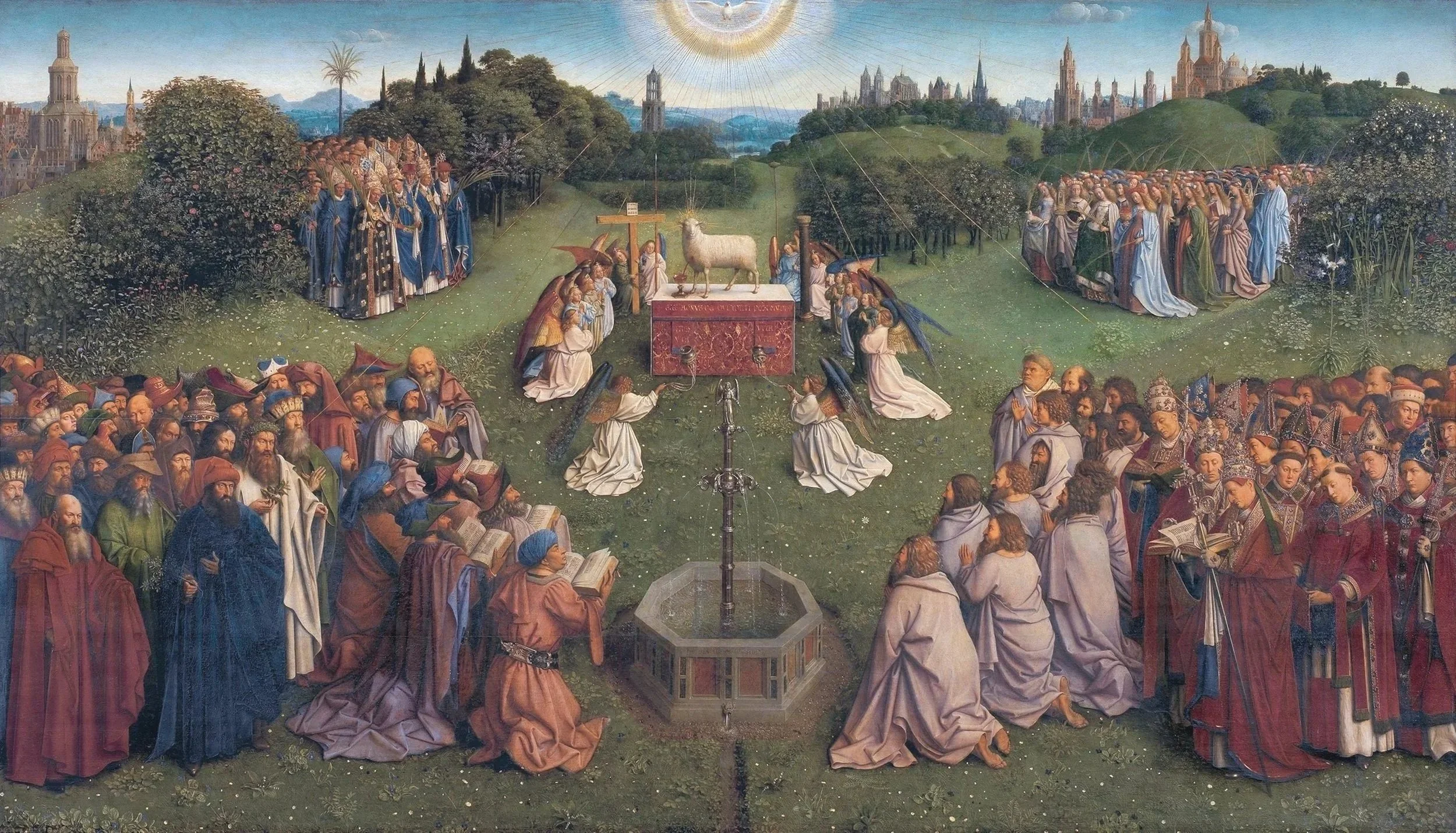
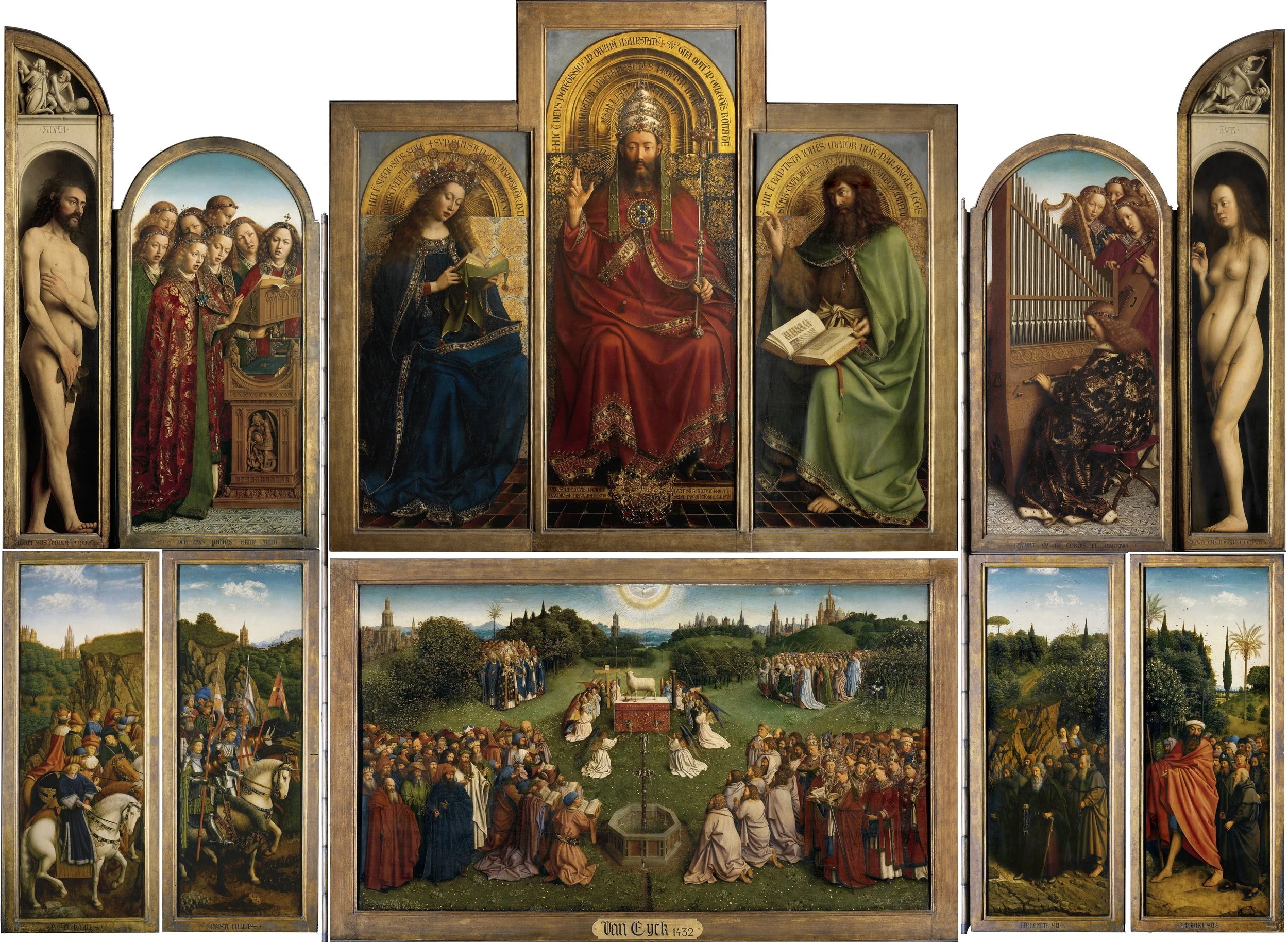

Jan and Hubert van Eyck, The Ghent Altarpiece, 1432. A great work of sacred art depicting the glory, sacrifice, and adoration described in Revelation.
The Images We Make of Him
No image of Yeshua will ever fully close the gap between the rendering and the subject. Some artists have tried to illustrate Yeshua’s earthly appearance from what we know historically, grounding their renderings in the physical reality of a first century Judean man. Others have reached toward something shaped more by their own culture and needs than by historical record. The feminized golden Christ of the Salvator Mundi, for example, tells us more about da Vinci than about the man from Nazareth whose physical strength and masculinity were inseparable from the demands of how He lived. There's also Sallman's blue-eyed portrait that's been hung in a hundred million homes, an image so ubiquitous it became, for much of the twentieth century, simply what Yeshua looked like. Generations grew up with that face. It shaped how they prayed, how they imagined Him, what they expected when they closed their eyes. What these artists captured was as much themselves as Him.
“What sits beneath every image ever made of Him is the deeper beauty. The beauty of a life lived in complete integrity with itself, and of a love that held absolutely nothing in reserve. ”
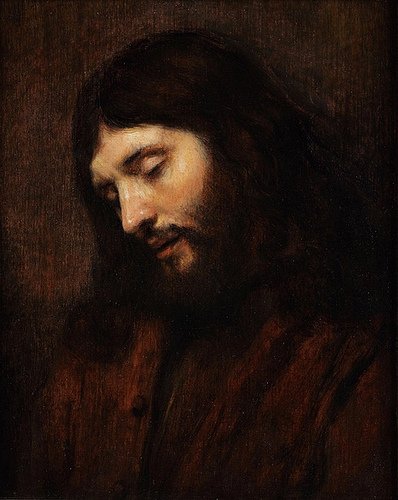
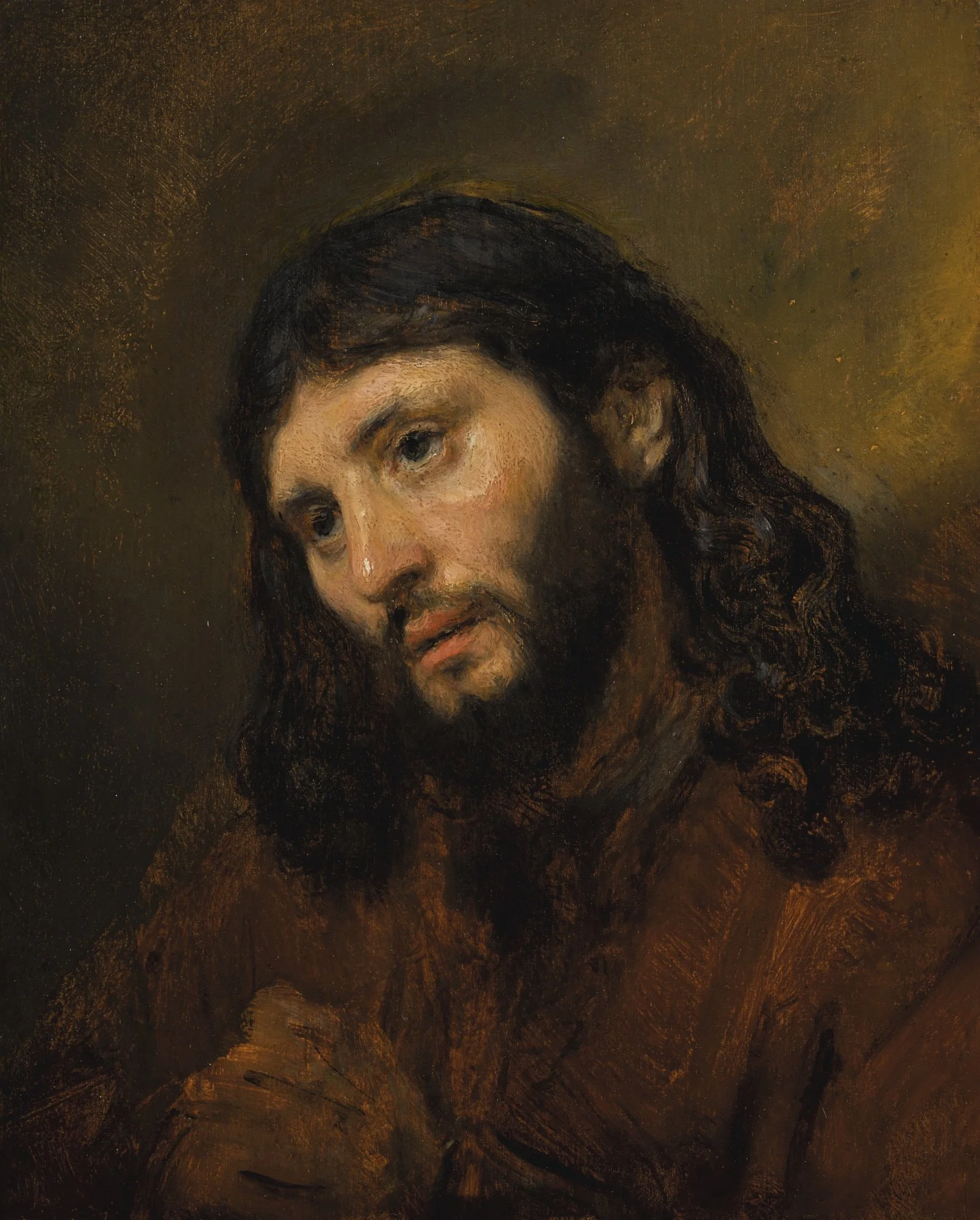
Rembrandt went further than most in his era, painting his Christ studies from a living Jewish model in Amsterdam rather than a European ideal typically used by his predecessors and contemporaries. The head studies are extraordinary. No one painted faces quite like Rembrandt. The way the expression is held open but with strength and clarity and focus feels unmistakably true to the Yeshua of the Gospels. An Ashkenazi face from 1640s Amsterdam is still a distance from a first century Judean man from the Levant, but Rembrandt was reaching toward something more honest than almost anyone before him, and it shows.
Every image of Yeshua falls short in some way, either too idealized, too cultural, or too limited by the hands and century that made it. And yet each one is reaching toward something real. Rembrandt more honestly than others. Da Vinci and Sallman more revealingly than they perhaps intended. The gap between the image and the subject has never closed. But perhaps that gap is the point, because what we are reaching toward when we reach toward Him is so much more than any face could hold.

What sits beneath every image ever made of Him is the deeper beauty. The beauty of a life lived in complete integrity with itself, of a love that held absolutely nothing in reserve. I think the beauty I reach for in Yeshua is both holiness and flesh together. The spirit that moved through Him and the body that housed it. A body that wept. That was anointed. That was strong enough to walk hundreds of miles and fast and spend hours in prayer and work and heal with its hands. A presence defined by compassion, extraordinary focus, and a willingness to go all the way to the end of what love costs.
You discover the weight He carried, the weight of a messianic life and the full brilliance of His teachings, and something in you needs to do something with it. To recreate it and make it physical again in whatever form your hands allow — marble, silver, paint, wood, words, music. As though the only honest response to encountering what He carried is to try to carry some small portion of it yourself. Perhaps that is the compulsion. Not a choice but a response.
And perhaps the artists were not the first to feel it. Long before any artist reached for a brush or a chisel, two prophets had already tried to describe what they saw. The artists felt it but the prophets saw it. Somewhere along the way, each of us was given an image of Yeshua. Most of us didn't choose it. It arrived the way so many formative things arrive — through the walls of a childhood home, a church, a culture, a painting reproduced on a thousand surfaces until it became simply what He looked like. We absorbed it before we had the language to question it, and it settled into us quietly, the way assumptions do.
It is worth sitting with where that image came from. Not with suspicion, but with curiosity. Every depiction of Yeshua tells us something about the people who made it — their century, their culture, their fears and longings, what they needed Him to look like in order to receive Him. None of them are lies exactly. All of them are partial. All of them are, in some sense, someone else's answer to a question that was always meant to be yours.
And perhaps that is exactly the point. Perhaps the absence of a face is not a gap but an opening. An invitation to encounter Him beyond the visual — beyond what we inherited, beyond what we were handed, beyond what someone else's imagination placed between us and Him. To meet Him in the Word itself. In the quality of His presence as the Gospels render it. In the mercy that did not hesitate, the love that did not stop, the silence that went all the way to the cross without breaking.
Every painting of Yeshua that has ever been made is, in this sense, an act of imagination, and some of those acts reveal their own blind spots and projections as much as they reveal anything true about Him.
What does He look like to you? What is the image you find yourself returning to when you think of Him? That is a question worth asking